- Developer
- Sucker Punch Productions
- Publisher
- Sony Interactive Entertainment
- Released
- October 2, 2025
- Genre
- Action-adventure
- Platforms
Overview
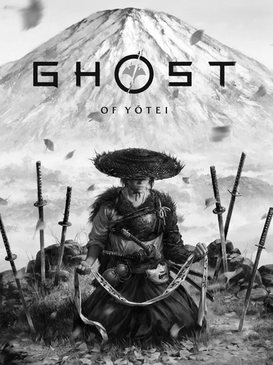
Ghost of Yōtei is a successor to Ghost of Tsushima, set more than three centuries later in 1603, in the lands of Ezo around Mount Yōtei. It follows Atsu, a woman who survived the murder of her family as a child and returns to hunt the six people responsible, the Yōtei Six.
Ghost of Yōtei moves Sucker Punch's samurai series forward to 1603 and north to Ezo, the land that would become Hokkaido. Atsu is a wandering mercenary whose family was murdered by a gang known as the Yōtei Six, and the game follows her quest for revenge across a frontier of snow fields, flower meadows and the shadow of Mount Yōtei itself. It is a standalone story with a new protagonist, and it does not require knowledge of Ghost of Tsushima.
Gameplay
Atsu has a wider arsenal than Jin did. She can use a katana, dual katanas, a yari spear, an odachi and a kusarigama, and each weapon is strong against particular enemy types, so switching between them is central to combat. Combat is fast and satisfying, with parries and counters at its heart. Stealth returns, and a wolf companion can join fights.
The open world is gorgeous and less cluttered than Tsushima's. You can set up camp, play the shamisen, and find side stories and bounties. Exploration is driven by curiosity rather than map icons. Some activities repeat, but the world is a pleasure to explore.
The biggest change is freedom. Instead of a linear chain of story missions, the Yōtei Six can be hunted in a flexible order, and the map is full of bounties, shrines, hot springs and camps that unfold naturally as you explore. Atsu's arsenal is broader than Jin's: alongside her katana she can master dual katanas, a spear, a kusarigama and the heavy ōdachi, and each counters particular enemy types, which turns weapon-switching into a tactical layer rather than just a stance change. Firearms appear for the first time, reflecting the era. A wolf companion joins fights, and quiet moments, like playing the shamisen at a campfire or painting with ink, give the journey room to breathe.
Combat is excellent, perhaps the best melee in any open-world game of its type, with parries and dodges that reward reading enemies' movements. Standoffs and duels return and remain dramatic. Some outposts repeat, and stealth is simpler than combat, but the variety of weapons keeps fights fresh to the end.
Atsu carries multiple weapons, katana, dual katanas, a yari spear, a kusarigama and the heavy odachi, and each is effective against certain enemy types, which encourages switching. A wolf companion joins her in battle, and the shamisen lets her play music to relax at camps. Bounties, hunting tales and duels with masters give structure to the open world.
Atsu's map is drawn from the stories and directions of the people she meets, so exploration is guided by rumors rather than icons, and the guiding wind returns.
Story
The revenge story is simple and focused. Atsu is a strong lead, and Erika Ishii's performance is excellent. The Yōtei Six are memorable villains. The game explores whether revenge can be satisfying and what happens after.
Set in 1603 in Ezo, now Hokkaido, the story follows Atsu, a mercenary whose family was murdered by the Yōtei Six, a group of outlaws, and her quest for revenge. Erika Ishii's performance as Atsu is excellent, and the story, with its flashbacks to Atsu's childhood, is personal and emotional.
Visuals & Audio
The game is stunning, with landscapes full of color. The music is beautiful. The Kurosawa-inspired black-and-white mode returns, along with other director-inspired modes.
Ezo is one of the most beautiful open worlds on any platform. Fields of flowers, golden sunsets, snowstorms and the ever-present volcano are rendered with a painterly eye. The game also offers distinctive presentation modes, including a black-and-white Kurosawa mode, and Sucker Punch added more after launch. The soundtrack mixes traditional Japanese instruments with sweeping orchestral themes, and Erika Ishii's performance as Atsu is fierce and vulnerable.
Optional modes include a Kurosawa black-and-white filter, a Miike mode for close-up violent combat and a Watanabe mode with lo-fi music curated by the director Shinichirō Watanabe, and they are fun ways to replay.
Performance by Platform
Ghost of Yōtei is a PS5 exclusive and runs smoothly with quality and performance modes. The PS5 Pro version offers better visuals.
Ghost of Yōtei is a PlayStation 5 exclusive. It offers fidelity and performance modes, with the performance mode targeting 60 frames per second. PS5 Pro owners get enhanced options. Load times are near-instant, and DualSense haptics are used for bowstrings, sword clashes and the shamisen.
Verdict
Ghost of Yōtei is a gorgeous, satisfying follow-up with a great lead and excellent combat. Its open-world activities can be familiar, but this is a confident sequel.
Few sequels improve on such a strong original while keeping its spirit. It is one of the best open-world games on PS5.
What works
- Atsu is a great lead
- Satisfying weapon-switching combat
- Gorgeous landscapes
- Focused revenge story
What doesn’t
- Some repetitive activities
- Familiar open-world structure